Detecting cybercrime-related activity is no longer the hard part. Today, many tools can flag ransomware samples, identify phishing campaigns, spot anomalous system behaviour, or trace suspicious cryptocurrency transactions. Detection has become faster, cheaper, and more accurate than ever.
Yet, when it comes to real investigations, detection alone rarely moves a case forward.
What investigators need is not another alert, but an understanding of how different pieces of evidence relate to each other. Who is involved. How actions are connected. What happened first, what followed, and what can be proven. This is where many investigations struggle (not because threats go unnoticed, but because information remains fragmented).
Detection gives signals. Correlation gives meaning.
In complex cybercrime cases, especially those that cross borders, data arrives in pieces. System logs here. Malware artefacts there. Online discussions on forums. Blockchain transactions. Forensic evidence collected from compromised machines. Each source tells part of the story, but rarely the whole one.
A detection-first approach treats these outputs as independent results. One tool flags a ransomware family. Another highlights unusual CPU usage. A third identifies a suspicious wallet. Useful, yes, but disconnected.
The problem is not the lack of data. It is the lack of context.
Without correlation, investigations become a collection of parallel analyses that never fully converge. Links between actions remain implicit. Timelines stay fuzzy. Attribution becomes speculative. And evidence, even when technically correct, lacks narrative coherence.
Correlation as the backbone of the intelligence picture
In ENSEMBLE, we deliberately approach cybercrime analysis from a different angle. Instead of asking “what can we detect?”, we ask “what can we connect?”.
The goal is to transform heterogeneous outputs (produced by different tools, at different times, and for different purposes) into a coherent intelligence picture. One that allows investigators to reason about relationships, sequences, and
impact.
At TREE, this approach is central to our role in ENSEMBLE. We contribute to the correlation and reconstruction of cybercrime incidents by linking heterogeneous evidence across sources, and to the centralised storage of data and digital artefacts that makes this analysis possible. By combining incident reconstruction with secure, structured evidence management, we help ensure that correlated intelligence remains usable, traceable, and forensically sound throughout the investigation lifecycle.
In practice, this means correlating entities such as IP addresses, file hashes, wallet identifiers, timestamps, online identities, and behavioural indicators across multiple data sources. By linking these elements, correlation makes it possible to connect technical artefacts with online activity, transactional data with behavioural patterns, and individual events with broader criminal
operations. It turns isolated signals into something investigators can actually work with.
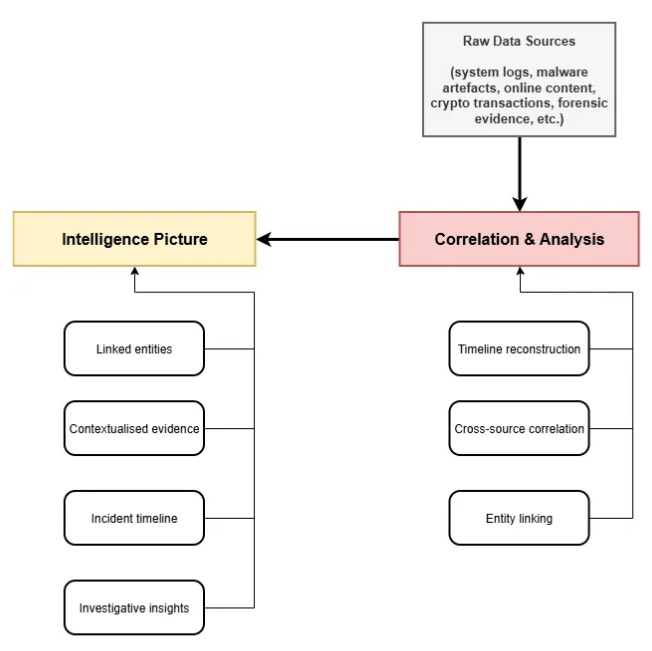
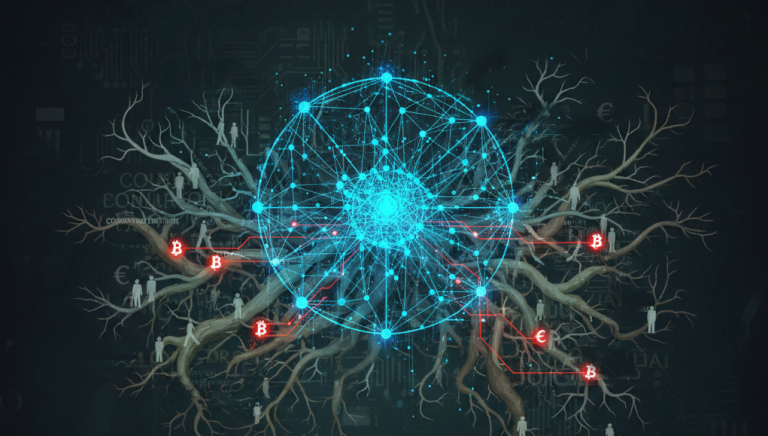
Figure 1: From raw data to intelligence picture. Conceptual overview of how
heterogeneous cybercrime data sources are correlated to support incident
reconstruction and investigative intelligence in ENSEMBLE.
From fragments to timelines
One of the most practical outcomes of correlation-driven analysis is incident reconstruction. When evidence from different sources is aligned and linked, it becomes possible to reconstruct how an attack unfolded over time.
This includes aligning technical events, behavioural indicators, and external intelligence on a common temporal axis, allowing investigators to distinguish causality from coincidence. The resulting timeline highlights escalation paths, dependencies, and decision points, providing a structured narrative of the incident.
Importantly, this is not just useful operationally. It also strengthens the forensic value of the findings. Evidence that is contextualised, traceable, and reproducible is far more likely to stand scrutiny beyond the technical team.
Correlation enables trust, not just insight
Correlation also plays a key role in collaboration. In cross-border investigations, sharing raw data is often impractical, sensitive, or simply overwhelming. What stakeholders need is contextualised intelligence, not unstructured artefacts.
By sharing correlated intelligence (rather than raw data) including explicit relationships, timestamps, and provenance information, investigators can communicate findings more clearly and validate each other’s work more effectively. Transparency in how conclusions are reached builds trust, both between organisations and across jurisdictions.
In high-stakes investigations, that trust is just as important as analytical accuracy.
Intelligence is built, not detected
Detection will continue to improve, and that is a good thing. But detection alone does not solve investigations. What makes the difference is the ability to assemble the pieces into something meaningful.
ENSEMBLE shows that intelligence is not something you simply extract from data. It is something you construct deliberately, through correlation, context, and reconstruction.
Detection provides the pieces. Correlation assembles the puzzle. Without it, even the most advanced tools remain isolated capabilities. With it, they become part of an intelligence picture that supports understanding, decision-making, and ultimately, justice.